Christmas stories
The Post Office for Lost Christmas Wishes
When an undelivered wish lands in her bicycle basket, Nell discovers a Christmas post office that cannot read an address until someone listens.
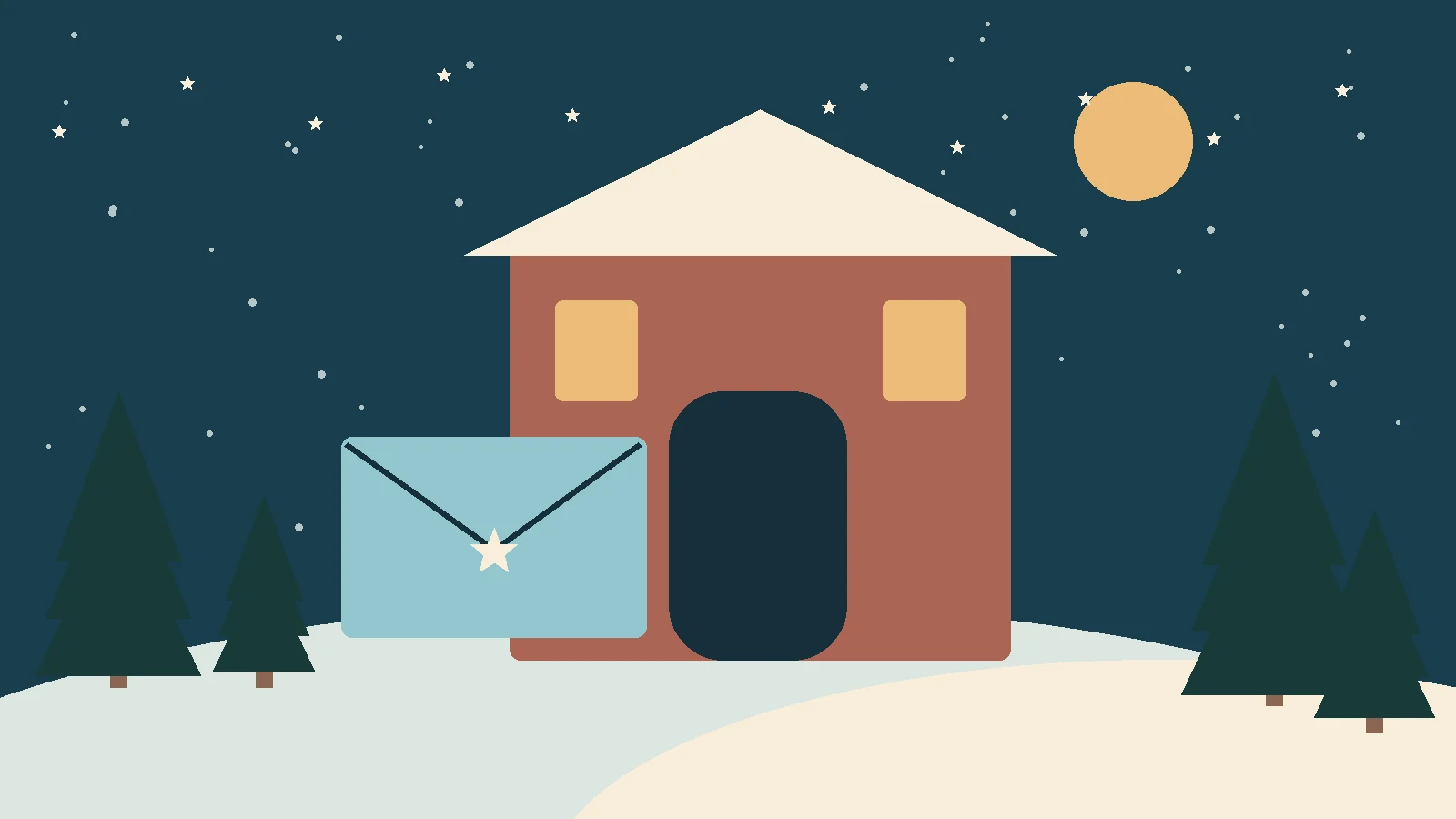
The envelope landed in Nell's bicycle basket between the carrots and the washing powder. It was pale blue, cold as a window, and addressed to SOMEONE WHO WILL STOP.
Nell stopped so abruptly that a carrot rolled into the gutter.
At the bottom of the envelope, in letters smaller than crumbs, someone had written: Before the last collection on Christmas Eve.
It was Christmas Eve. The church clock was striking four.
She took the letter to the ordinary post office, where Mr Vale was drawing the blind. He examined the address through his glasses, then over them. Finally, he looked at Nell.
"Ah," he said. "The other counter."
Behind the stamp cupboard was a door she had never seen. Mr Vale opened it, revealing a room full of blue envelopes. They lay in baskets and pigeonholes, between coat buttons, even inside an enormous kettle. A little brass machine was stamping every one with the same word: UNHEARD.
"We deliver wishes people couldn't quite say," he explained. "But we can't deliver this one. No proper address."
Nell opened her envelope. Inside, a small square of paper read: I wish somebody would let me do the useful thing.
She immediately knew what it meant. Her little brother Kit had been forbidden to hang the glass ornaments. She rode home, fetched a wooden star, and let him put it on the tree. He beamed. The letter, however, remained perfectly blue.
"It usually turns gold when you've found the person," Mr Vale said when she returned.
"You could have mentioned that."
"I thought I did. I may have told the kettle."
Nell tried the toy shop. Perhaps the useful thing was testing a train. She tried the bakery, where a boy was tying ribbon around cake boxes. Neither attempt changed the envelope. Meanwhile, the brass machine stamped faster. Outside, the first flakes of snow dissolved on the pavement.
Then Nell noticed something on the paper: a small round mark, like a teacup stain. It smelled faintly of oranges.
The Christmas supper at the community hall had orange punch every year. Nell hurried there, leaving her bicycle beside the ramp. Through the windows she could see adults unfolding tables and children laying paper hats. Mrs Finch stood near the door in her best red coat.
"You look busy," Nell said.
"Everybody else does."
Mrs Finch had once organised the supper. Since her knee operation, people kept telling her to sit down. A chair had been placed for her beside the radiator, far from the kitchen and all the conversations.
Nell held out the letter. "Is this yours?"
Mrs Finch read it. Her mouth tightened, then softened.
"I didn't post anything."
"Apparently that isn't important."
The envelope warmed, but it did not turn gold.
Nell had an excellent plan. She found a light basket of napkins and put it on Mrs Finch's lap. "You can fold these."
Mrs Finch folded one into a neat triangle. "Thank you."
Nothing happened. Nell looked at the envelope, then at the napkins, annoyed with both. She had finally found the right person. Why wasn't the wish finished?
From the kitchen came a crash, followed by three people asking where the big serving spoons were. Mrs Finch drew breath. Someone hurried past and said, "Don't worry about it. You enjoy your rest."
Nell sat down.
"What useful thing did you mean?"
Mrs Finch set the napkin aside. "The seating. Mr Abbas needs to hear people clearly, so he shouldn't sit beside the kitchen. The twins will only eat if they're opposite each other. And Ruth is coming alone for the first time. She will say any seat is fine. It won't be."
Nell had never considered that arranging chairs could require knowing so much about people.
She carried over the seating chart. Mrs Finch pointed. Nell moved names. They placed Ruth beside the librarian, who knew when to speak and when to leave a comfortable silence. Mr Abbas got a quiet corner. The twins faced each other across the shortest table.
Then the hall caretaker announced that the heating had failed at the far end. Half the tables would need moving.
Nell groaned. "We've just finished."
Mrs Finch studied the room. "Bring the round tables together. Leave the ramp clear. Put the drinks near the kitchen so nobody carries hot cups through the crowd."
This time Nell did not assign her a smaller job. She asked the caretaker to bring the whole team over.
By six, the hall was warm with voices. The serving spoons had been discovered in the cupboard labelled SERVING SPOONS. Mrs Finch sat near the entrance, welcoming people and directing them to their places. She was still sitting comfortably. She was also running the room.
In Nell's pocket, the envelope turned the colour of toast.
Mr Vale was waiting outside the post office when she arrived. He took the golden paper gently.
"Delivered?"
"I nearly delivered it wrong. Twice."
"Only twice? Excellent work."
He reached for the hidden door, but Nell caught his sleeve. A new blue envelope had appeared beside the kettle. This one said: I wish someone would ask why I don't like Christmas crackers.
Nell thought of all the questions she usually answered without asking them.
"Will these still be here tomorrow?"
"Some wishes," Mr Vale said, "take longer than Christmas."
She went home with the carrots, the washing powder, and an empty basket. At the supper later, Kit asked whether she had found any presents while she was out.
"An address," she said.
Across the room, Mrs Finch lifted her cup. Nell lifted hers back. Neither of them needed to explain.
The end.