Christmas stories
The Gingerbread House with a Front Door
Bea is determined to win the Christmas baking contest. But her gingerbread house has an unexpected visitor who needs a way inside.
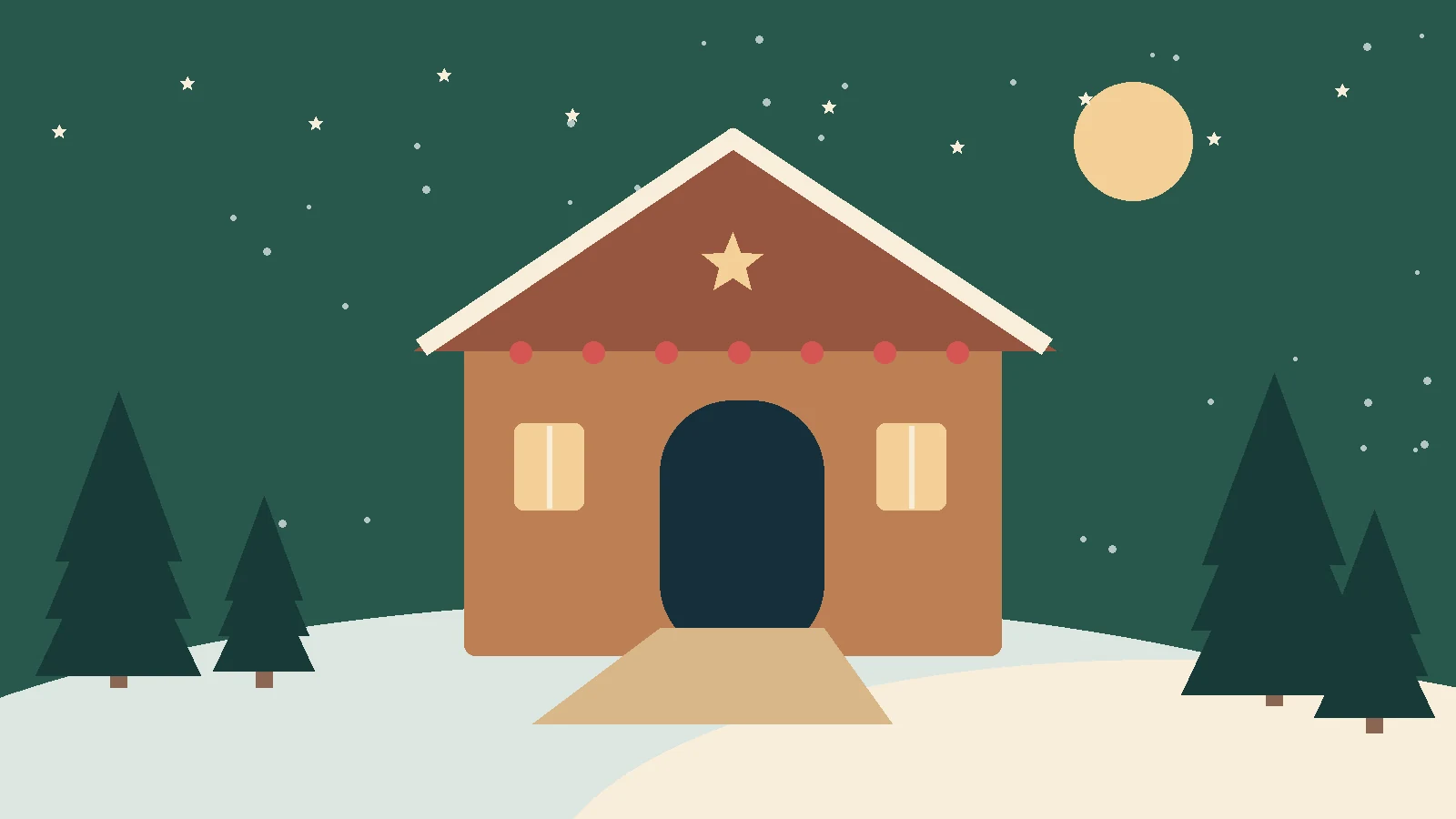
Bea's gingerbread house had a peppermint chimney, twelve biscuit windows, and a roof so straight that Dad took a photograph of it before anything could go wrong.
Something went wrong at 4:12.
A tiny person in a flour-dusted coat knocked on the front wall.
"Lovely house," she said. "Where's the door?"
Bea pointed to the rectangle she had drawn in icing.
The tiny person tried to turn the sugar handle. It snapped off.
"That's a picture of a door."
"It's a gingerbread competition," Bea explained. "Nobody actually lives in them."
"Then why have you made a house?"
Bea had no answer that didn't sound slightly silly.
The visitor introduced herself as Crumb, a gingerbread surveyor. She had a ruler made from a cinnamon stick and a clipboard no bigger than a postage stamp. Her job was to inspect houses on the night before the Christmas fair.
"I've spent three hours outside decorative doors," she said. "My feet are freezing."
Bea looked at the contest rules. Best Appearance. Most Inventive Design. People's Favourite. She had already planned where the blue ribbon would hang in her bedroom.
Cutting a real doorway might crack the wall.
She offered Crumb a thimble of warm milk. Crumb thanked her, sat on an upturned cupcake case, and waited without saying anything more. This was somehow worse than complaining.
At last Bea asked Dad for help. He checked the wall and brought a small serrated knife. Together they carefully cut around the icing door. A corner broke off.
Bea stared at the damage.
"We can repair it," Dad said.
"It won't be perfect."
"No. It will have a door."
They attached the biscuit with a ribbon hinge. Crumb stepped inside. Then she backed out again.
"Three steps?"
Bea had built them from sugar cubes because they looked grand. Crumb's measuring trolley stood beside the cupcake case. Its wheels were smaller than the steps.
"You could carry it."
"I could," Crumb agreed. "Every time I visit. In the rain. When I'm tired. Or you could build a little ramp."
Bea took off the sugar cubes. She made a ramp from a spare biscuit and propped it with marzipan. It looked less like a palace and more like the library entrance.
Crumb rolled inside happily. Through the windows, Bea could see her measuring the kitchen.
That was when the second knock came.
Outside stood a gingerbread postman with a broad hat. His hat would not fit through the doorway. Behind him waited a woman carrying twins, and a tall person whose head brushed the peppermint gutter.
"Did you invite everybody?" Bea asked Crumb.
"I said I'd found somewhere we could get in. News travels."
Bea sat down hard. By now she would have to change the front wall entirely. All afternoon's work, all those neat little windows, all her careful symmetry—it seemed unfair that helping one person had produced so many problems.
Dad did not tell her to be generous. He set a broken gingerbread panel beside her and asked, "Which part do you want to keep?"
"The roof. And the chimney. And the garden."
"Which part isn't working?"
She pointed.
They replaced the narrow doorway with an arch. Bea used the broken pieces to build a curved bench around the garden. The twins' mother sat there while the postman delivered a letter to Crumb. The tall visitor hung a star from the chimney without needing a ladder.
By bedtime, the house was crooked in two places. One window had become a serving hatch. A red liquorice strip made the ramp easier to see. The blue-ribbon space on Bea's bedroom wall looked rather ambitious.
In the morning, the tiny people had gone. Their footprints remained in the icing snow. Crumb had left a certificate: FIT FOR VISITING.
At the fair, Bea put the certificate beside her entry. The neighbouring house had perfect sugar-glass windows and a working chocolate fountain. Bea tried not to stare at it with envy.
A little girl came to look at her ramp. She rolled a toy rabbit up it, through the door, and into the kitchen.
"Again," the girl said.
Other children gathered. Someone sent a wooden dinosaur through the arch. Someone else's toy bus parked by the bench. Bea asked them to be gentle with the roof, then watched her house become the busiest place on the table.
She did not win Best Appearance. That went to the chocolate fountain, which was fair. She did not win Most Inventive Design either.
Near the end of the afternoon, the judges brought her the People's Favourite ribbon. It was green, not blue.
Bea held it carefully. Winning still felt wonderful. She decided she didn't have to pretend it hadn't mattered.
But when Dad asked where she would hang the ribbon, she looked at the tiny open doorway.
"On the garden bench," she said. "So everyone who visits can see."
That night she left the house on the kitchen table. Beside it she placed a thimble of milk and a note: Door's open. Please mind the roof.
By morning, the milk was gone. The roof was exactly where it belonged.
The end.